Öèððîç ïå÷åíè
Â.Å. Ñèíèöûí, Ä.Â. Óñòþæàíèí
Îòäåë òîìîãðàôèè Èíñòèòóòà êàðäèîëîãèè èì. À.Ë.Ìÿñíèêîâà ÐÊÍÏÊ ÌÇ ÐÔ, Ìîñêâà, Ðîññèÿ 3-ÿ ×åðåïêîâñêàÿ óë, 15à, E-mail: ust@tomography.ru
Пациент
ВозраÑ�Ñ‚: 27 ëåò
Пол: муж�кой
�намнез
Ïàöèåíò áûë àìáóëàòîðíî íàïðàâëåí â íàø öåíòð äëÿ ïðîâåäåíèÿ ÊÒ è ÌÐÒ èññëåäîâàíèé. Æàëîáû íà áîëü â æèâîòå, ïîâûøåíèå òåìïåðàòóðû, òàõèêàðäèþ. Ïÿòü ëåò íàçàä ïàöèåíò ïåðåíåñ âèðóñíûé ãåïàòèò Â.
Выполненные и��ледовани�
ÊÒ ïðîâîäèëàñü íà ñïèðàëüíîì êîìïüþòåðíîì òîìîãðàôå â îäíîñðåçîâîì ðåæèìå, òîëùèíà ñðåçà 10 ìì, áåç êîíòðàñòíîãî óñèëåíèÿ. ÌÐÒ ïðîâîäèëàñü íà 1-Òë ÌÐ òîìîãðàôå ñ ïîìîùüþ Ò1- è Ò2-âçâåøåííûõ èìïóëüñíûõ ïîñëåäîâàòåëüíîñòåé ñïèí-ýõî, òóðáî ñïèí-ýõî, FLASH, à òàêæå ïðîâîäèëàñü äâóìåðíàÿ ÌÐ ôëåáîãðàôèÿ (ïîñëåäîâàòåëüíîñòü FLASH), òîëùèíà ñðåçîâ 8 ìì, áåç êîíòðàñòíîãî óñèëåíèÿ.
Об�уждение
Cirrhosis is the destruction of normal liver tissue which is replaced with nonfunctioning scar tissue surrounding areas of functioning liver tissue and nodules of pathologic regeneration. The scar tissue and regenerative nodules compress portal tracts and cause portal hypertension with dilatation of varicose veins at the lower part of the esophagus, enlargement of the spleen and fluid accumulation in the abdomen (ascites). Spectrum of imaging findings of the cirrotic liver includes: 1. Changes of the liver’s margin; 2. Liver atrophy and hypertrophy; 3. Diffuse heterogeneity. The process of cirrhosis distorts the hepatic parenchyma. Although present in all patients with end-stage cirrhosis, this distortion has a variable effect on the configuration of the liver’s margin which may be smooth, nodular (fine to coarse “cobble stone” margin with nodules < 3 cm), or grossly lobular (deformed by more than one nodule > 3 cm). Margins that are smooth or deformed by multiple small nodules are typical for micronodular cirrhosis, whereas a coarse nodularity of the margin is the result of macronodular cirrhosis. However, lobular livers are usually the resullt of marked subsegmental atrophy and hypertrophy rather than of large regenerative nodules (1). Approximately 25% of end-stage cirrhotic livers are normal in size and configuration; 36% are diffusely atrophic. Most of the remaining end-stage cirrhotic livers exhibit a combination of segmental atrophy and hypertrophy (1). Main cause of heterogeneity of the liver in CT and MR images is diffuse fibrosis. In our case the liver’s margin is nodular with nodules < 3 cm that are typical for macronodular cirrhosis, the liver’s size is normal. Diffuse fibrosis is clearly depicted in unenhanced CT and T1-weighted MR images as patchy, poorly defined region of low attenuation. In T2-weighted MR images fibrosis looks like some regions of high signal intensity of similar configuration as seen in unenhanced CT. Enlarged abdominal lymph nodes can be detected with CT in approximately 50% of patients. They are more common in the portacaval space and porta hepatis (2). Liver cirrhosis is the prime risk factor for hepatocarcinogenesis. Kubicka et al. showed that among patients with hepatocellular carcinoma 74.6% had liver cirrhosis (3). Moreover, Rodriguez et al. showed that the risk of hepatocellular carcinoma increased to 17% after 5 years of follow-up in patients with Child stage A or B cirrhosis (4).
Окончательный диагноз
Ìàêðîíîäóëÿðíûé öèððîç ïå÷åíè
�дре� �луча� в интернете
http://www.tomography.ru/cases.php?id=1
|
Ри�унок 1a 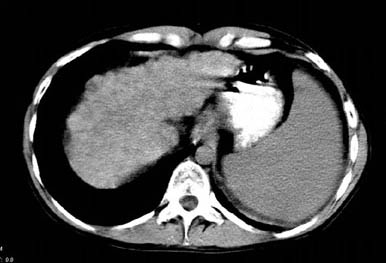
Ри�унок 1b 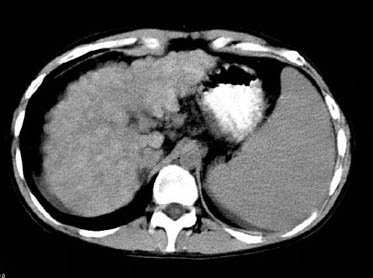
Ри�унок 1c 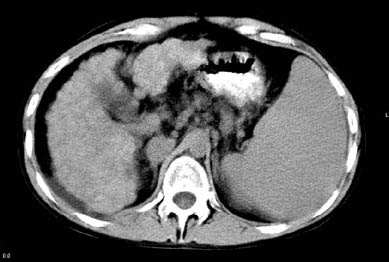
Ри�унок 2a 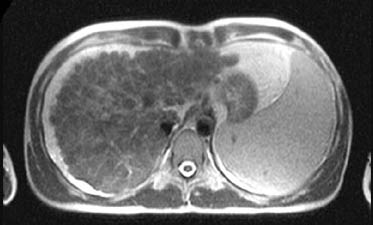
Ри�унок 2b 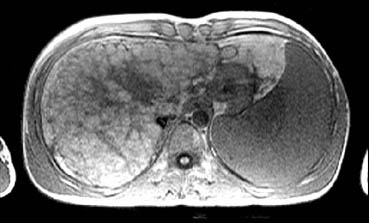
Ри�унок 2c 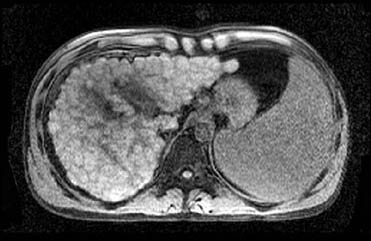
Ри�унок 2d 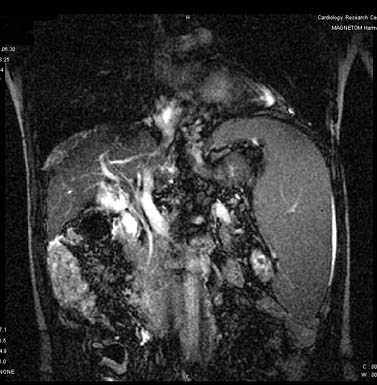
Ри�унок 2e 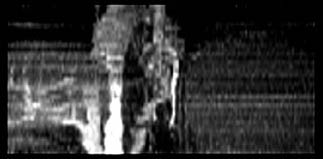
|